
FILM REVIEW: Mobile Suit Gundam Hathaway 2 is highly rewarding, but only if you're already deep into Gundam
A nuanced and considerate drama, for seasoned Gundam fans seeking a mature story.

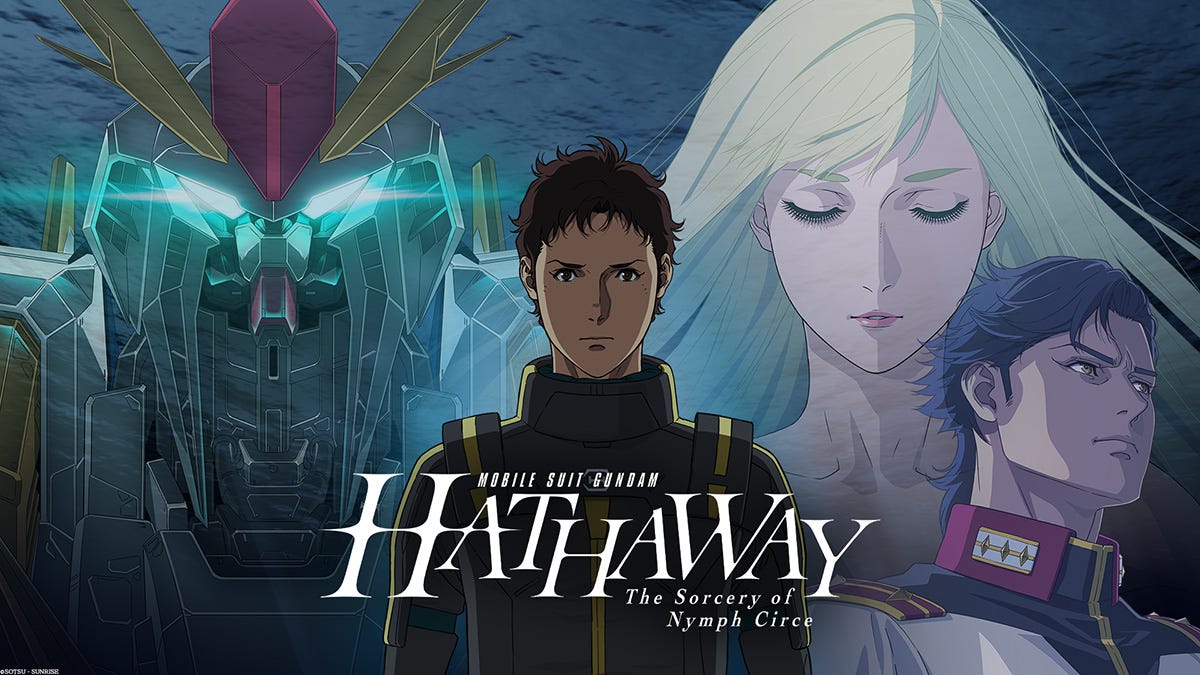
Film: Mobile Suit Gundam Hathaway: The Sorcery of Nymph Circe — Release: May 14th, 2026 — Format: DCP 2K
The year is Universal Century 0105. In the wake of the failure of the Neo Zeon movements, the hand of the Earth Federation has tightened its grip around spacenoids and the colonies. Fascist jackboot thugs known as Manhunters are sent into the streets of Earth to deport “illegal aliens” into space, while the rich and powerful hoard what little arable land remains on our planet. The dominance of the Earth Federation is maintained through the use of mobile suits, piloted mecha that have replaced fighter jets as the military doctrine both on Earth and in space.
Yet the tyranny of the Earth Federation does not go unopposed. Hathaway Noa (Ono Kenshō / Caleb Yen), son of One Year War veterans Bright and Mirai Noa, takes the nom de guerre of Mafty, and leads an eponymous ecoterrorist movement against the same corrupt Earth Federation that his father has fought for decades to protect. In this, he is opposed by Colonel Kenneth Sleg (Suwabe Jun’ichi / Aaron Phillips), commander of the anti-Mafty Circe Unit, and mobile suit pilot Lane Aim (Saitō Sōma / Kieran Walton). Caught in-between Hathaway and Kenneth is the titular “nymph sorceress”, Gigi Andalucia (Ueda Reina / Megan Shipman), a kept woman discovering her own agency after a lifetime of exploitation.
Now, if terms like “Universal Century”, “Mobile Suit”, “Neo Zeon” and “One Year War” have zero meaning to you, this is where you turn back! Mobile Suit Gundam Hathaway: The Sorcery of Nymph Circe is a highly rewarding film for fans deeply engrossed in Gundam’s decades-spanning metanarrative, but the Hathaway trilogy is simply not a good entry point for those unfamiliar with Gundam.
In order to grasp the context of this film trilogy, adapted from the Hathaway’s Flash novel trilogy written by franchise creator Tomino Yoshiyuki from 1989 to 1990, you need to have seen, at a minimum: Mobile Suit Gundam from 1979-80 (43 episodes), Mobile Suit Zeta Gundam from 1985-86 (50 episodes), Mobile Suit Gundam ZZ from 1986-87 (47 episodes), and the feature-length film Mobile Suit Gundam: Char’s Counterattack from 1988. And last, of course, you must see the first Gundam Hathaway film before watching Nymph Circe…or re-watch it considering the previous Hathaway film came out five years ago and your memory may be fuzzy.
I can’t blame prospective Gundam fans for finding the Universal Century timeline daunting to enter. If you’re looking for a bite-sized chunk of this setting that’s largely self-contained, I recommend the six-part miniseries Mobile Suit Gundam 0080: War in the Pocket, which is a great way to see whether the style and tone of Gundam fit your taste, and can be watched in a single night. However, if you are already a fan of Gundam, and have been waiting decades to see the tale Tomino-san wrote of Hathaway Noa after the Axis Shock, this film will exceed your expectations.
The pinnacle of Gundam, in my opinion, is the seamless fusion of grand political conflict with intimate interpersonal drama. Each entry has commentary not just on politics as an abstract concept, but how we as human beings are supposed to connect with each other. “Newtypes”, akin in Gundam to Star Wars’ Force, have evolved the psychic ability to sense the intentions and feelings of others. The Earth Federation sees the potential of this power to bridge human understanding, yet instead they abuse Newtypes to create terrible weapons of war.
Both Lane and Gigi in the film are Newtypes, and while one is a military pilot and the other is a sex worker, there are strong thematic parallels in how they are both exploited for their minds and their bodies by members of the Earth Federation in order to enrich and empower the imperialist elite. I find the use of Gigi’s character in this way, comparing the exploitation of a soldier to that of a sex worker, to be an incredibly inspired piece of political commentary.
Further, I greatly appreciate the depiction of Hathaway’s own Newtype abilities; he is quite literally haunted by Newtype ghosts, terrified to connect with living human beings in the same way he did with those who now persist beyond death in his dreams. He is shown as increasingly neglectful of his own mental health, descending into ideological antifascist fervour to the detriment of his own sanity, to mask the trauma of his ordeal at the Axis Shock.
Yet it is the visceral nature of the Earth Federation’s fascism that makes Nymph Circe and the novel it’s adapting feel more relevant than ever. I watch the film, and I see the Earth Federation commit heinous massacres as the witnesses struggle to send evidence of the war crimes to media, and I see the Earth Federation government use their close ties to the elites who own mainstream media to suppress the war crime footage from public consumption, and then I see the Manhunters drag “illegal aliens” off the streets and out of the airports somewhere they’ll never be seen again.
But when I see these things in the film, I do not see the thin veneer of science fiction. The entire concept of Gundam slips my mind, as I am drawn to mental images of the United States and their paramilitaries like ICE, perpetuating horrors in the name of imperialism. In the Hathaway subseries, I see incisive social analysis that has only grown in resonance, speaking not to a far-off world of robots and space colonies, but rather the real fascism that has manifested in our lives today.
With a brief aside to musical score, Sawano Hiroyuki returns from several previous Gundam projects to compose the OST, and his orchestral suites for Nymph Circe iterate in an interesting way on the leitmotifs he established for the previous film. Curiously, for the opening and closing tracks of the feature, licensed music from SZA and Guns N’ Roses is chosen rather than featuring Japanese artists, and while the lyrics of these licensed tracks are admittedly thematically relevant to the plot, the style of the music is unfortunately quite incongruous with Sawano-san’s compositions.
Overall, Mobile Suit Gundam Hathaway: The Sorcery of Nymph Circe has a great deal of substance, with a lot of meat on the bone for seasoned Gundam fans looking for nuanced political and personal drama amidst the spectacle of mobile suit combat. I eagerly await the conclusion of Hathaway Noa’s trilogy.