
FILM REVIEW: Project Hail Mary is a grand adventure made for the biggest of screens
Full of visual splendour, with heart and humour to match.

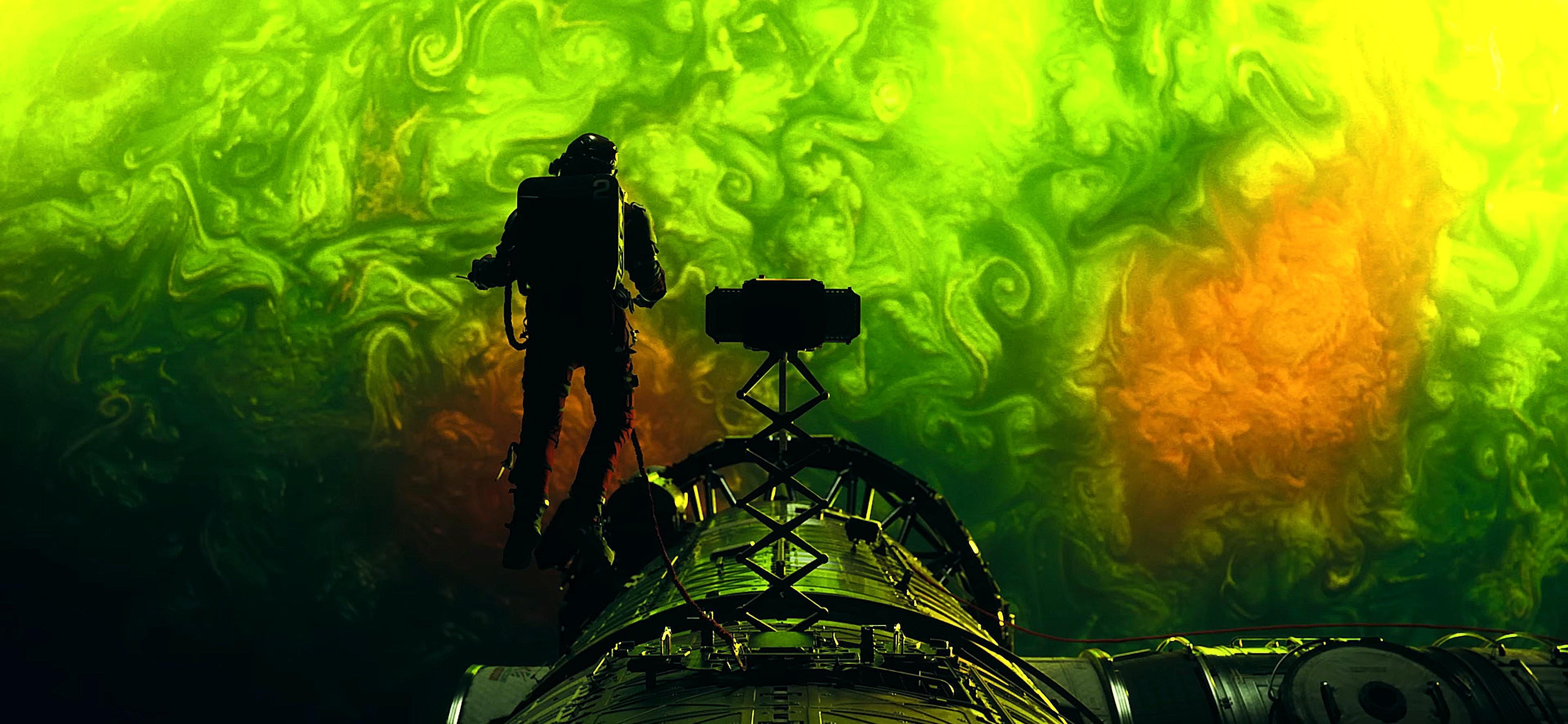
Film: Project Hail Mary — Release: Mar 20th, 2026 — Format: IMAX 70mm
Waking up from a medically-induced coma on an interstellar craft about to complete its journey through space, Dr. Ryland Grace (Ryan Gosling) does not remember who he is. All he knows when he first explores his ship is that he is the sole survivor, his two crewmates failing to survive the cold sleep to their destination.
Slowly, as Dr. Grace’s memory returns to him, he remembers his mission, if not how he got onboard the ship. On Earth, researchers led by Eva Stratt (Sandra Hüller) of Project Hail Mary discovered that microscopic life known as “astrophage” has grown in the atmosphere of Venus and spread to the Sun, consuming our star’s energy and warmth and threatening to cause a devastating ice age that will kill billions.
Even worse, this astrophage has spread to other stars surrounding our own, threatening to eradicate the conditions for life across our wider galaxy. But one star, Tau Ceti, is curiously unaffected, and by breeding the energy-rich astrophage, humanity is able to create the fuel for an interstellar ship that can make a one-way trip to Tau Ceti.
There, the crew will attempt to discover what makes their star immune, and hopefully send a solution back to Earth before too much of humanity has been consumed by the ice age. Success is not guaranteed, and it will still take 12 years for their solution to arrive back on Earth due to the limitations of the speed of light. Yet this is humanity’s “Hail Mary” pass down the field, throwing everything into one desperate chance that we might survive. And thus, our hero’s adventure begins.
Without spoiling any strict plot details, Project Hail Mary is directed by Phil Lord and Christopher Miller, famous for their work on Cloudy with a Chance of Meatballs, The LEGO Movie, the Spider-Verse films, the 21 Jump Street films, and cult classic Clone High. These two know how to mix comedy and drama while maintaining a coherent tone.
The screenplay is written by Drew Goddard, adapting a novel of the same name by Andy Weir. This is fitting, as Goddard also wrote the screenplay for the well-regarded adaptation of Andy Weir’s The Martian, which starred Matt Damon. I find that Goddard grasps the tone of Weir’s work well, and that this tone is a good fit for Lord and Miller’s strengths as directors.
As the film’s plot proceeds, the action fluctuates between the present situation at Tau Ceti, presented in full 1.43:1 IMAX glory, and Dr. Grace’s gradual recollections of his past, filmed in anamorphic 2.39:1. This trick is relatively simple as far as playing with aspect ratio goes, but it works well enough in shifting the mood. However, if you’re sitting in the front half of an 1.43:1 IMAX auditorium, the view during the flashback scenes will require you to angle your neck upwards, or recline your seat back into the legs of the audience member behind you.
In terms of plot, I find the adventure in Dr. Grace’s present more compelling than the flashbacks to his past that provide context for why he’s aboard. There are some open questions in the film’s plot that are addressed more explicitly in the book, but not only do I think the movie is stronger for eliding over them, I think that the movie would have been better if it went further into obscuring Dr. Grace’s past on Earth.
If the Earth scenes do serve any narrative purpose, though, it’s to show how Dr. Grace finds his purpose out near Tau Ceti, not when he’s bounded by Earth’s gravity. And he finds his community when he finds an alien, “Rocky” (James Ortiz), sent to Tau Ceti by his own people for the same reason as Dr. Grace, to find a solution for the astrophage. They learn to communicate so they can work together to save both their homes, and also the galaxy as a whole.
The contrast of a pessimistic Earth with an optimistic and hopeful cosmos is a striking thematic choice. Dr. Grace has more to fear from other humans than he does from Rocky. He and other Eridians are distinctly not humanoid in any fashion, looking more like spiders made of rocks, but the choice to use practical puppetry and have one of the puppeteers do the voice gives Rocky a visceral physical presence that Ryan Gosling can act off of.
The buddy film dynamic is very endearing, even if the plot doesn’t have too much depth or nuance. There’s a lot of enjoyment to be derived out of watching two people experience funny and scary moments together while pursuing a shared quest, and I would say this tonal difference is what distinguishes Project Hail Mary from works like Interstellar when otherwise it could be considered too derivative.
If I have any serious complaints, the ending, while good enough, drags on for a bit of time. There’s a moment when it feels like the movie is about to end, and then suddenly it kicks back up only to end shortly after that. With a tighter ending, the film could have cut some slack weight towards the end of the runtime that drags down otherwise perfect pacing.
Overall though, Project Hail Mary is an enjoyable popcorn flick, with lots of emotional highs to fill the runtime with. It is a visual feast, and it would be a disappointment to only experience it on TV at home.