

For several years now, I’ve had the occasional dream where I find myself in a rather curious room, a cross between the bridge of the starship Enterprise and a cramped submarine deck. I couldn’t place it to a memory, and wasn’t sure if it was something I had seen as a child on a trip, or whether my sleeping brain was creating fiction.
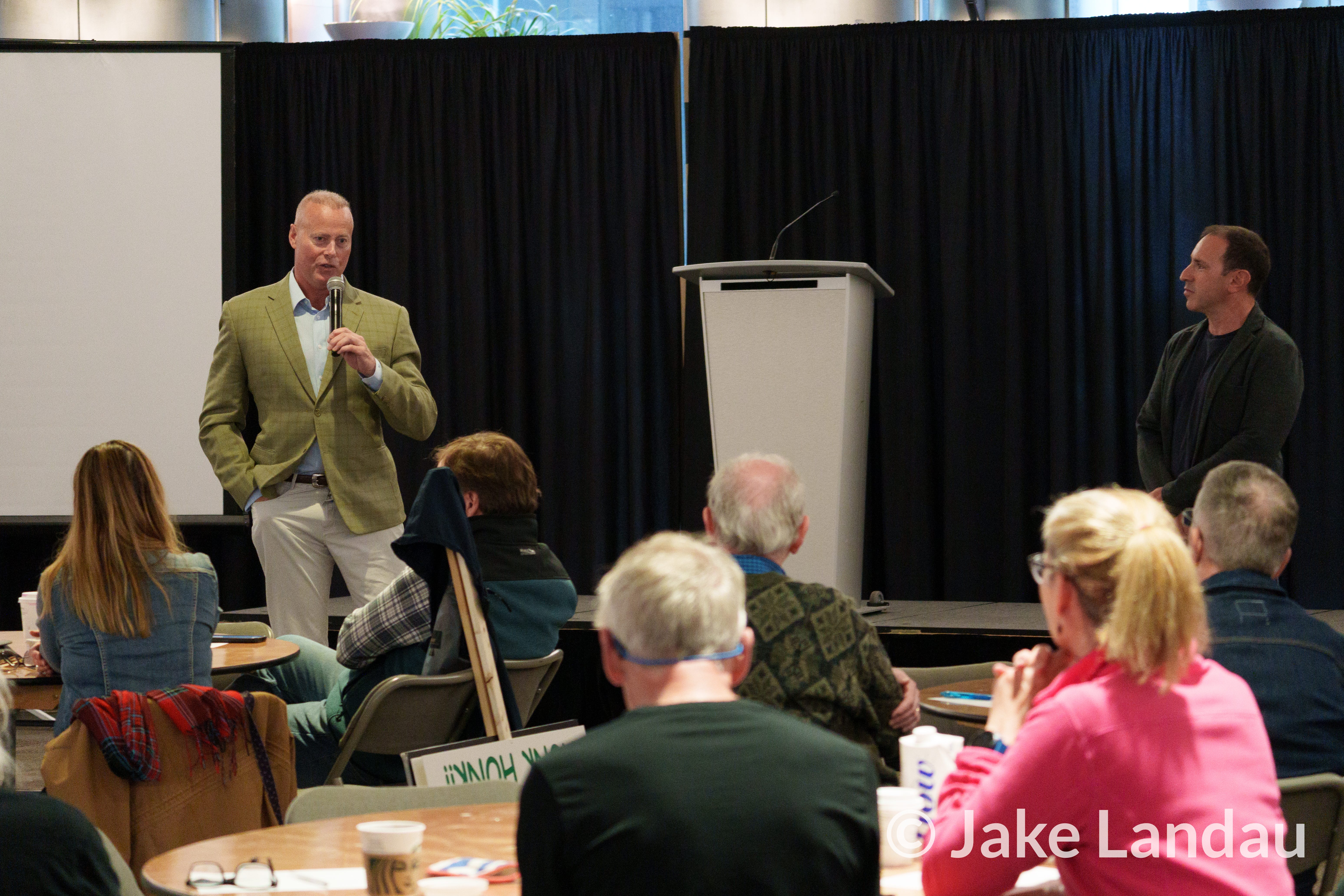
What I realized, upon arriving at an event held by Save Ontario Science Centre organizer Jennifer Alexander and starring Toronto City Councillors Josh Matlow and Jon Burnside as well as architects from Moriyama Teshima, the firm founded by Science Centre designer Raymond Moriyama himself, was that this room was indeed a real place.
Looking at the displays that had been put up showing space that could be reused inside the three-building Science Centre campus, I saw one of the schoolrooms for visiting classes of students, and it was exactly this space that has haunted my dreams. I finally realized that I had been in this room with my class on one of our own field trips, and it hit me viscerally at the moment that my younger siblings, one a baby and the other a toddler, aren’t able to share these same experiences that I had.
The thought of making sure this space is accessible to the next generation was only exemplified by what I heard repeated today by many Torontonians. Person after person took the microphone during the Q&A to talk about the various things they saw children love at the Science Centre and that they wanted the next generation of children to enjoy as well. In that room, I saw a group of people bound by a shared vision to do better for their kids, and if you’ll pardon a rather non-scientific adjective, I thought it was magical.
As Councillor Matlow made clear to me during his scrum with the press after the conclusion of the panel, Mayor Olivia Chow has not updated him or the rest of Toronto City Council on her so-called “new deal” with Premier Doug Ford for the municipal government to take occupancy of the Science Centre campus and run their own programming.
In Matlow’s view, Toronto has to figure out exactly what the community wants to do with each of the different spaces within Buildings A, B, and C, and then they can make a proposal for splitting costs to other levels of government and private sponsors based on the expected total for the project. While Councillor Burnside didn’t stay long enough for the press to scrum him, he did mention that costs are something to keep in mind for every planned use.
As Brian Rudy—Partner at Moriyama Teshima—put it in his own remarks and during the Q&A panel, the likely future for this building is multi-use. Thankfully, everyone present wants to resume some form of science museum programming, but due to the sheer size of the facility, there is an understanding that it can best serve the community by doing a few different things, especially as Buildings A and B featured large and empty halls during the Ontario Science Centre’s years of operation. These buildings also featuring an IMAX Dome theatre and a live theatre respectively, each with hundreds of seats.
And as various people took the microphone, there was a veritable fountain of suggestions as to what these uses could be. Some suggested reopening the class and teaching spaces—those same that captivated my dreams in the lede above—for K-12 students, college and university students, and even adults doing continuing education.
One woman, who worked for more than thirty years at the Ontario Science Centre, talked about the importance of Kidspark, an educational playground that integrated science lessons intuitively into fun activities that kept kids engaged, and then another woman immediately piped up to mention how she and her friends got memberships solely so they could take their kids to Kidspark repeatedly and burn out their energy. For my part, this is exactly what my own mother did with my sister and I, and thus I can vouch for the success of this parenting tactic in keeping high-energy kids busy.
Further ideas for redeveloping spaces included a community market in the entry hall of Building A, increased community access to the ravine around the building through trails, a museum of museums featuring different satellite galleries from other museums, and a beekeeper who wants to restore the former apiary at the site and provide honey to the public. In every case, these ideas were put forward by thoughtful citizens who want to see the City of Toronto restore this space as a multigenerational hub.
If a restoration of the Science Centre campus is to happen in the Don Valley, however, it will require both financial and political capital. Councillor Burnside himself said that between Mayor Chow and her aspiring challenger Brad Bradford, neither have talked about the Science Centre so far during this municipal election period.
On October 26th, Torontonians will vote for our Mayor and our City Council, and it will be essential to the revival of the Science Centre for Toronto to pick a group of elected officials with the political will to accomplish this task. The details are up for negotiation, but the holistic desire to bring this space back to life is a necessity for any candidate.
If this group of committed people manages to succeed in even partially reoccupying the Science Centre campus, it will be a victory. And while it may be a long and winding road for the community, the government and the architects to work toward that reopening date, I look forward to the time when I can finally take my sister and brother with me to the Science Centre, and show them the place that we’ve kept alive in our dreams.
An excellent but also revealingly disappointing note. Two bright city councillors are making a genuine effort to mitigate the damage done to the city by our moronic Premier, and the Mayor of Toronto is somehow making her own plans behind closed doors. I don’t doubt Mayor Chow’s intentions, but it’s become clear as day that she’s incapable of managing the future direction of Toronto.