
The 536 Finch West streetcar is open, and it's really slow!
Why are we calling this thing "Line 6", when it's clearly not?

In 1990, the Toronto Transit Commission opened the 604 Harbourfront LRT, a tram service running out of Union Station downtown. This service was numbered “604” because what we call TTC Lines 1 to 3 today were then internally numbered as 601 to 603; the TTC believed that the Harbourfront LRT, solely by having dedicated lanes rather than being in mixed traffic, deserved to be on the same tier as a metro line.
They were wrong. NIMBYs who opposed any intensification in the neighbourhood hated the idea of an “LRT”, but loved Toronto’s streetcars for their nostalgia factor. Paradoxically, others in the public quickly understood that LRTs and streetcars are the same thing, and did not appreciate the cynicism of politicians in branding LRTs as a new thing.
To satisfy both voter constituencies at once, by the year 2000 the 604 had fully transitioned into the 509 Spadina and 510 Harbourfront streetcars, officially folded into the TTC’s 500-series tram network. And absent a small plaque you can see at Union Station on the wall when you walk onto the streetcar platform commemorating the 1990 opening of the “LRT”, there’s virtually no hint that they were ever considered a different thing.
Anyway, the Line 6 tram opened on Finch West yesterday, covering much of the former route of the 36 Finch West bus (which now terminates at Finch West station), and branded by Metrolinx and the TTC as an “LRT”. And from my experience riding “Line 6”? I can’t help but wonder how long it will be until this streetcar gets a 500-series number too.


Now, before I rip into this project too heavily, I want to make it clear that I’m offering constructive criticism. I have no ideological opposition to trams, I just believe they should be used in the right places, built with the right design, and operated with the right policies. So let’s quickly go over what this project does right.
While it is substantively still a tram service and should not be branded differently from the 500-series legacy streetcars, there are lessons learned that have led to better design. Like Metrolinx does with the GO Train, fares are paid on the platform rather than when they board the train, removing the bottleneck.
In addition, rather than using unidirectional trams that turn with wide loops, these newer trams are bidirectional and can use diamond crossovers to reverse direction both more quickly and with less space. Finally, they use modern double-point switches instead of the almost archaic single-point switches on the 500-series streetcars, enabling faster speeds when moving over them.
Unfortunately, the Finch West tram also carries the same core weaknesses as Toronto’s 500-series streetcars. There are not enough trams in service, and the ones that are in service get held up at every intersection due to a lack of transit signal priority.
Firstly, trams will only arrive every 10 to 12 minutes for the majority of the day, and even in the morning and afternoon rush hour periods, it is still just every 6.5 minutes. This is notably worse frequency than the Finch West bus service that these trams replace, and in addition, transit advocate Steve Munro has demonstrated that the trams will actually move slower than the buses did, despite those buses not having their own lane of traffic!
While Metrolinx claimed travel times would be roughly 33 to 34 minutes across the length of Line 6, reaching speeds of ~20km/h, in service the TTC has instead scheduled for 46 minutes. During the rush hour service this morning, a CBC reporter took 55 minutes to run from east to west, a speed of just ~11km/h; for context, the CBC notes that over 400 runners in the Toronto Marathon’s 10K event this year ran in less than 55 minutes, meaning they can easily outpace a train.
What’s truly frustrating is that Line 6 does have transit signal priority built-in and ready to activate, but the City of Toronto under Mayor Chow has opted to only put it in “limited” mode. Unless the tram is behind schedule, it will be forced to stop at every red light.


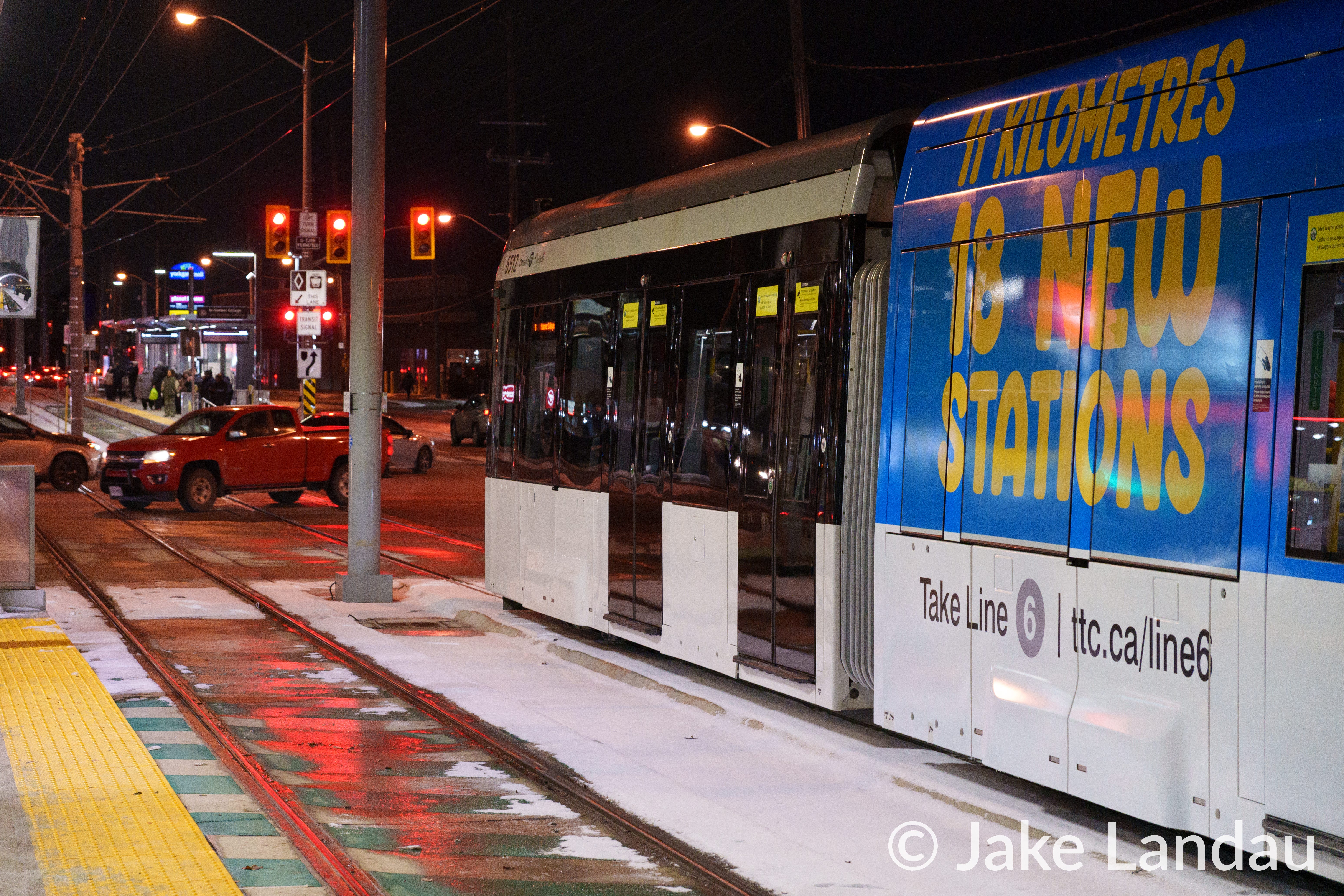
In the header image for this column, you can see how a Line 6 tram needs to stop twice, once to let cars left turn in front, and then a second time to pick up passengers on the other side of the intersection. This pattern is so egregious that City Councillor and TTC Board member Josh Matlow has publicly called for active transit signal priority to be implemented.
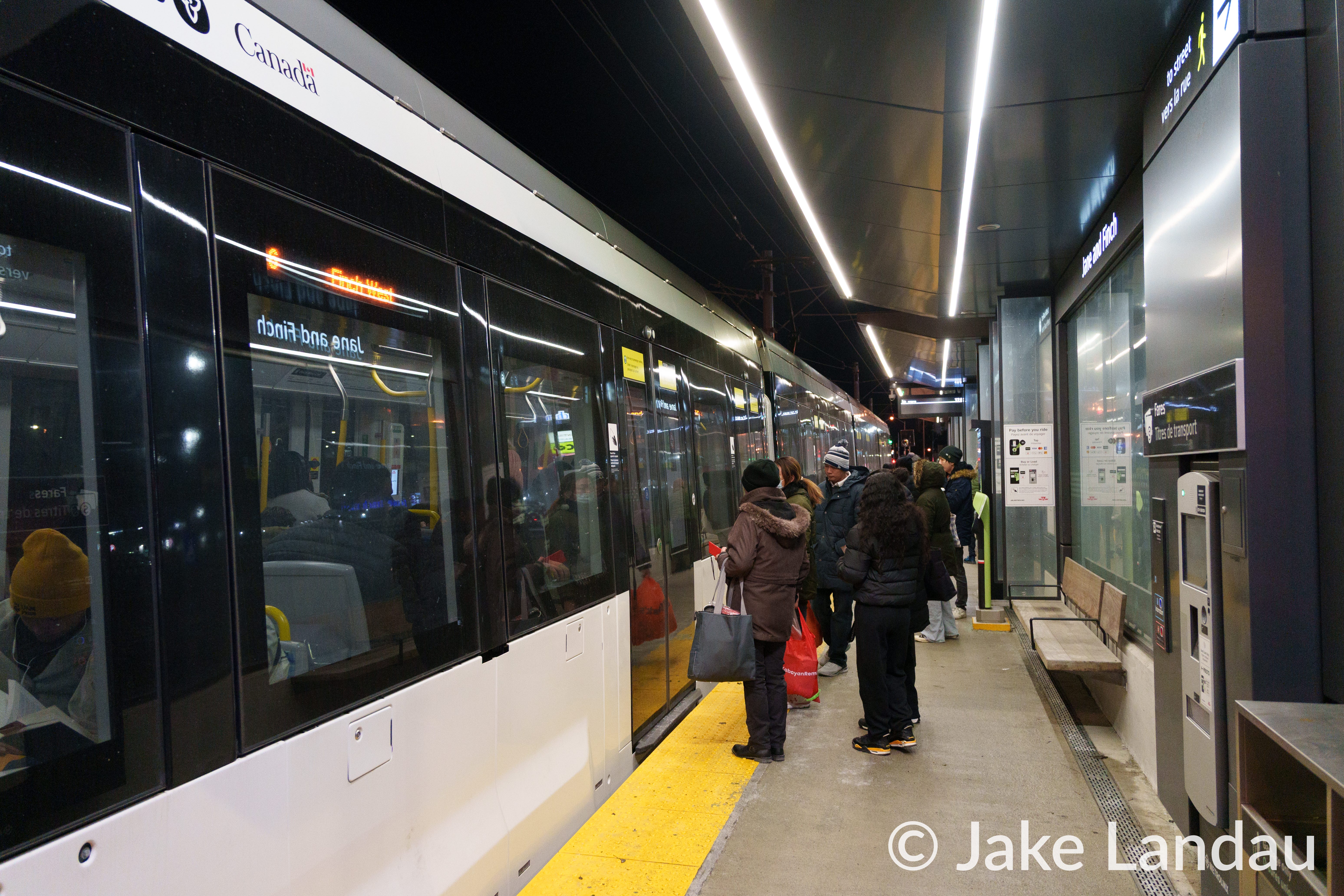
While I find the Finch West station to be incredibly overbuilt with a winding, cavernous tunnel between Line 1 and Line 6, I find the opposite to be true for the street-level stops, which make up 16 of the 18 stations along the Finch West tram. All of these have exactly the same layout: Split platforms each on one side of the intersection, set in the median in the middle of the road, requiring you to wait for the crosswalk and potentially miss your tram.
These “stations” are virtually identical to the stops on the 509/510/512 streetcar lines, with almost zero shelter from the elements. In the winter cold as I rode the line and took these photos, I noted that waiting ten minutes for a tram will be very painful, as there are zero heating elements anywhere on the platform to keep passengers warm, an absurdity when people will be riding this line in subzero temperatures.
As people continue to ride “Line 6”, I do believe that the amount of money spent on this project will be a problem. The promise of “LRT”, and Transit City as a wider program, was that rather than building real metro lines, you could spend tram money and get something almost as good as a metro.
But with the bloated cost of the Finch West LRT, we’ve actually got it the other way around; we spent the amount of money a metro line would cost, and at the end we’ve only got the capacity of a small, cramped tram. With a final price tag of $3.7 billion CAD for this streetcar, we have spent roughly the same amount of INT$ per kilometre that France and China spend to tunnel a metro.
And not only have we overpaid, we have a tram that now operates far below the trams of other cities when it comes to frequency and speed. We are unwillingly to implement policies like transit signal priority and pedestrianized urban design that would make trams part of walkable cities rather than six-lane stroads.
The people who live in this part of Toronto, who will use this tram to commute and visit family and friends, could make a fair argument that they are worse off with Line 6 than they were with the 36 bus. It is slower, it has fewer stops, and it doesn’t come as often.
I don’t know if Line 6 will end up going down the road of the Harbourfront LRT before it. Maybe it will stay as-is, or maybe it will be renumbered to the 536 Finch West streetcar. The label isn’t actually important, as evidenced by me jumbling around “tram” and “streetcar” and “LRT” for the past 1,500 words of this column.
What does matter to me is that the people in Toronto who rely on trams, be they the 500-series or Lines 5 or 6, have access to a version of that transit which is good. I expect Toronto City Council to embrace policies that will make trams faster, even if it makes cars slower.
Is that really too much to ask?