

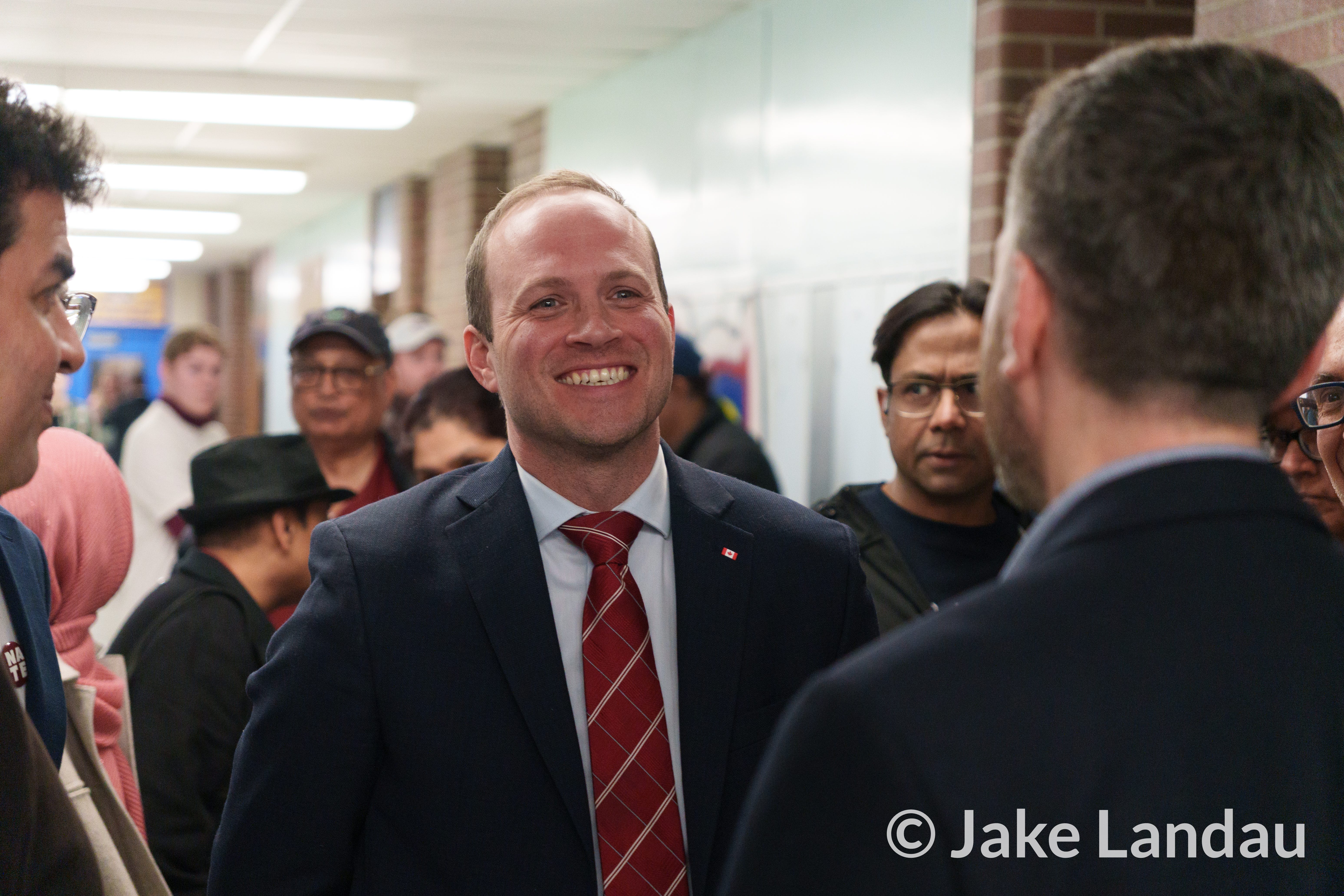
The Ontario Liberal Party has officially released the written decision in the appeal launched by Nate Erskine-Smith after his loss of the party nomination in Scarborough Southwest, and the verdict is in: his claims are all summarily dismissed, without any serious consideration.
Interim Leader John Fraser and Party President Kathryn McGarry have both thanked the three-person Arbitration Committee, and insisted that now is the time to bury the issue and focus on winning the upcoming by-election in Scarborough Southwest. Yet upon reading the actual published decision, I can’t help but wonder whether this was a kangaroo court designed to squash the truth rather than reveal it.
And since many journalistic outlets have simply quoted parts of the decision rather than the entire thing, here is the link to the full written decision, which you can pull into a separate tab as we walk through it together with my analysis and commentary. I have also embedded the PDF into this column, so you can download it if it ever gets removed from the Ontario Liberal website.

As p. 1 of the decision summarizes, and as reported by my own publication, Mr. Erskine-Smith lost on the final ballot to Mr. Hafiz by a slim margin of 19 votes, 718 to 699. Citing irregularities, which he summarized in a post on his personal Substack, Mr. Erskine-Smith filed an appeal to the Arbitration Committee of the Ontario Liberal Party in accordance with the party’s internal rules and procedures.
In p. 2, the panel led by David Zimmer as Chair (former Liberal MPP and Cabinet Minister), Jennifer Norman (current Mediator for the Ontario Labour Relations Board), and Adam Goldenberg (Yale Law School graduate and current Partner at McCarthy Tetrault) describes the appeal as being held on May 20th in Toronto, where I confirmed with my own scouting on that day that it was held at 18h00 ET on the fourth floor of the Sheraton Centre across the street from Toronto City Hall, and according to my sources lasted until roughly midnight.
Then, p. 3-4 of the decision, concluding the summary, describes Mr. Erskine-Smith’s allegations of irregularities that would invalidate the result, only for the Arbitration Committee to declare that there were no irregularities that affected the vote or the integrity of the meeting, and that “Ahsanul Hafiz was the true winner of the vote”, summarily dismissing the appeal.
Breezing over p. 5-8 shows basic procedural rules for this hearing that show that all parties and their legal counsel agreed on basic standards for how the appeal would be settled. Not only were both Mr. Erskine-Smith and Mr. Hafiz represented by counsel, but also the Returning Officer for the nomination contest, who is kept anonymous in the written decision, but my sources confirm can be identified as Sean Torrie, whose day job is as Litigation Counsel at Beneva.
But curiously, in p. 9-11, the Arbitration Committee explicitly declares that the rules for nomination contests are “more flexible” and that “candidates may be appointed by the party without any nomination vote at all.” While technically true, I would not boast about such things in the lede of a decision that is supposed to claim there was indeed a fair contest!
Going into p. 12, the Arbitration Committee, with the consent of all parties to the appeal, leans upon the precedent of Supreme Court of Canada decision Opitz v. Wrzesnewskyj (2012), a split 4-3 decision in which failures to ensure voters had ID were not considered by themselves enough proof to overturn a general election. Using Opitz as the framework, Mr. Erskine-Smith needed to prove not only that irregularities occurred, but that they happened in a way that allowed unqualified people to vote, and that this happened enough times to influence the result.
With the conclusion of the basic ground rules and framework for determining this appeal, so does the agreement between involved parties in this case conclude. Launching into p. 19, it is declared that “[Mr. Erskine-Smith] has not established that any individual who was not entitled to vote voted at the nomination meeting. Nor does the evidence call into question the integrity of the nomination process.”
In p. 21-22 it is conceded that 34 more ballots were counted than there were voters struck off the list of Ontario Liberal members in the riding. Yet in p. 23, this is counter-intuitively argued as evidence that these are ballots that all went to eligible voters, despite clearly raising the spectre that they weren’t!
According to p. 24, Ontario Liberals voting in Scarborough Southwest would attempt to obtain a ballot from a Deputy Returning Officer, and if the DRO determined they did not have suitable credentials, they would be deferred to a credentials table run by Milton Chan, Legal Counsel for the Ontario Liberal Party, with a form indicating their name and the deficiency in their proof of ID and residency. If credentials then approved them, their form would be designated as such. Scrutineers from all nomination contestants were present in the room to witness this throughout the day.
The Arbitration Committee claims in p. 25 that only five people had a ballot issued despite the objections of a scrutineer. Further, in p. 28, Returning Officer Torrie asserted to the Arbitration Committee that 20 voters had their credentials form approved by Mr. Chan without then being struck off the voters list, reducing unaccounted for votes to 14, lower than the 19 vote threshold which Mr. Erskine-Smith lost by.
Yet in p. 31, Mr. Erskine-Smith asserts that there are 14 credentials forms marked “not eligible to vote” where those voters were then, inexplicably, crossed off the voter’s list and granted ballots anyway. Confoundingly, the Arbitration Committee asserts in p. 32 that this is acceptable because they could have simply come back later to vote again despite being deemed ineligible…even though such a thing would obviously prove to be a breakdown in the “integrity of the nomination process” as the Ontario Liberal Party puts it themselves.
Further, there is an irregularity which Mr. Erskine-Smith and his people alleged that is not included in this appeal decision at all, and that is the missing ballot tally sheet. Every DRO is handed a tally sheet along with their stack of blank ballots. A ballot is only valid if it has the signature of the DRO at the bottom, and at the end of the day, the tally sheet has to be included with the ballots and show that the number of blanks at the start equals the number of the blanks at the end plus the number of names struck off the voter’s list. This is a further breakdown in the basic accounting measures that ensure the integrity of the contest, and it goes completely unacknowledged.
Going into the rules for how ID was actually verified on the day of voting, Mr. Erskine-Smith contested in p. 38 that people were using electronic copies of documents rather than paper originals, and also using paper originals that were not in the approved list of acceptable proof circulated before the meeting. On the former point, the Arbitration Committee fairly points out that in other Ontario Liberal contexts, “original” does not necessarily mean paper, and that an original document can come in an electronic format.
On the latter point, however, the argumentation borders on the absurd. Through p. 45-46, the Arbitration Committee rules that the Returning Officer had the power to change the list of acceptable ID at their whim in the middle of the voting period, and that they even have the power to grant voters ballots despite having no proof of ID at all. When you combine the arbitrary granting of ballots to voters with the vote total discrepancy listed above—something the Arbitration Committee curiously did not consider as potentially related—there appears to be a large gaping hole in this entire process.
In p. 53, it is claimed that Mr. Erskine-Smith failed to note that Mr. Chan could be biased against him until after the meeting, when bias claims are supposed to be raised at the earliest practicable opportunity. Yet members of Mr. Erskine-Smith’s team insist that they did note this, raising the question of why such contrary testimony was not included by the Arbitration Committee in this written decision. Surely someone isn’t telling the truth here, and the written decision needs to address that a factual discrepancy exists and decide what the reality of the matter is?
Concluding the bias section, p. 55 elides over my report of an Ontario Liberal shadow campaign waged by supposedly neutral party staff assisting Mr. Erskine-Smith’s opponents, simply stating that “the Ontario Liberal Party is a volunteer-driven organization and there are only so many of us who are willing and able to give of our time to support the party and its activities.” This only seems like a good argument for delegating partisan nomination contests away from parties themselves, and into the hands of Elections Ontario to manage professionally with the backing of public funds.
On the topic of ballot secrecy being regularly pierced by voters taking photos of their ballots, the Arbitration Committee waves this away in p. 58 by saying it is merely evidence of a “lively nomination meeting attended by diverse array [sic] of voters”, and that without proof of it being connected to a vote buying campaign, there is no concern to be had here. Again, in p. 59 the Arbitration Committee claims that Mr. Erskine-Smith’s team delayed in raising a complaint, while from the public viewpoint his team has raised these complaints from the beginning.
As such, p. 60-61 summarily dismiss the appeal, and affirm that Mr. Hafiz will remain the Ontario Liberal contestant for Scarborough Southwest. Even if we take this at face value, Mr. Hafiz will have a great many questions to answer regarding his calls for political violence against opponents of his family in Bangladesh. But we have good reason to not take this written ruling at face value, considering the way in which it addresses, and refuses to address, various pieces of evidence.
This entire affair has raised significant doubts as to whether the Ontario Liberal leadership contest in the fall will be conducted in a fair manner. It is obvious why Mr. Erskine-Smith may no longer find the prospect of running for this leadership attractive, although his credentials as an outsider being persecuted by the establishment have certainly received a boost with grassroots voters in Ontario.
I can see the argument for Ontario Liberals disappointed with this ruling to keep their membership and try to vote in a better leader in the coming months. Nobody wants to completely cede control over their political movement. Yet there is also a valid argument for simply leaving the Ontario Liberal insiders to rot by themselves. Why provide them your time and your labour and your money, when the Ontario NDP and the Ontario Greens are both viable alternatives?
If the Ontario Liberal establishment thinks this story is over, they are sorely mistaken. This is a moment that called for transparency and reflection, and instead they chose to insist that the blatant inconsistencies right in front of us mean absolutely nothing. And while the Ontario Liberals have had some good polling, the next election is still years away, and bitter infighting may well cause them to crash back down to Earth.
Thank you very much for this. It’s disappointing that when the province is in desperate need of a credible alternative to Ford, the Ontario Liberal Party is such a mismanaged wreck.