
The first Ontario Liberal Leadership debate was pointless
With little in the way of clash or substance, these ninety minutes were a waste.

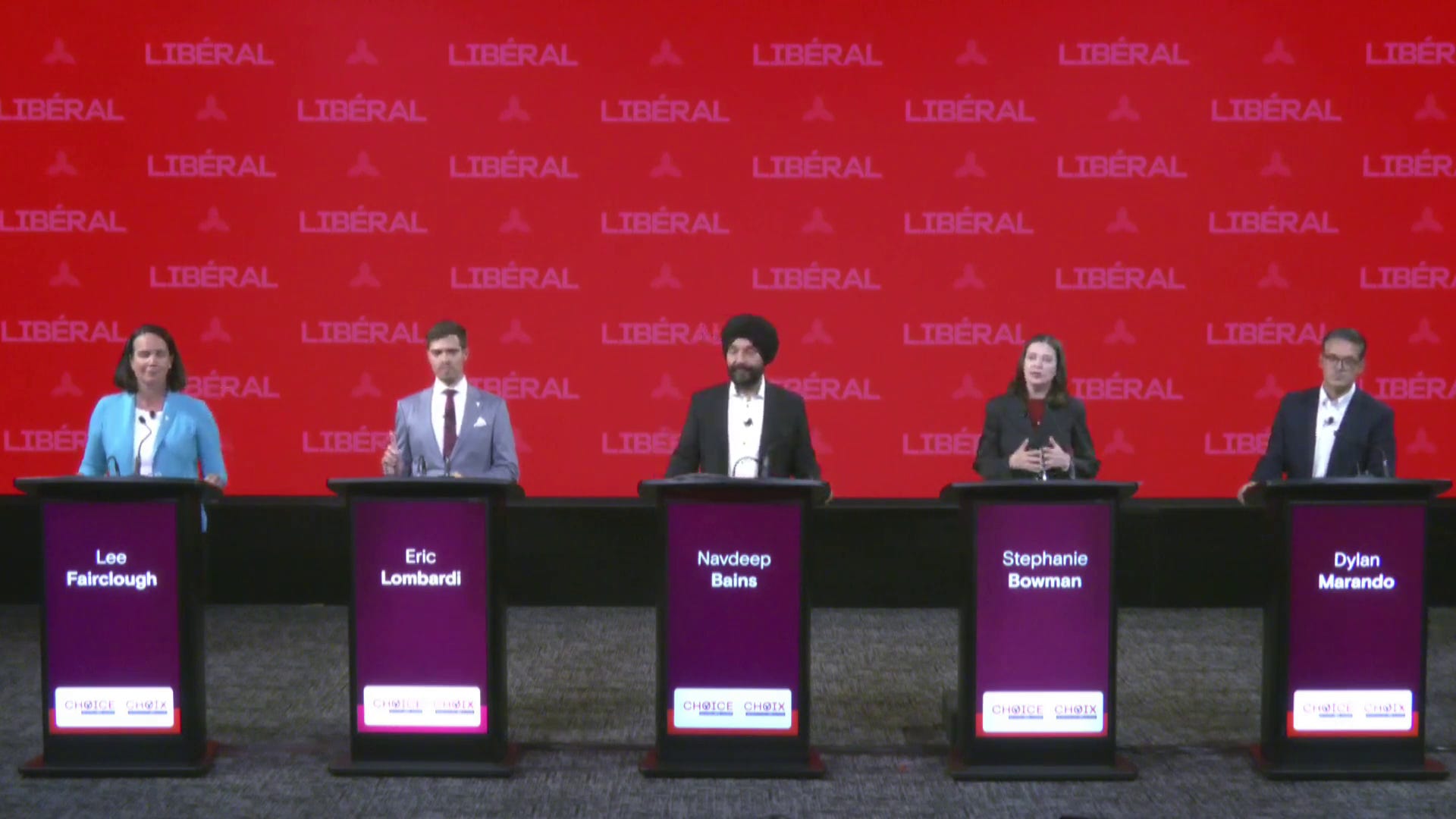
Unless you’re deeply clued in to Ontario’s provincial politics, you probably didn’t know that on Monday night, the Ontario Liberals—third-place finishers for three straight elections—held the first debate in their leadership contest, triggered after Bonnie Crombie formally resigned as party leader in January.
Moderated by Tina Yazdani of The Trillium and filmed on a closed set at a studio in the City of Brampton, five candidates have made it to the debate stage. Notably, none of these candidates are Nate Erskine-Smith, who opted against running for the Ontario Liberal leadership after narrowly losing a highly contentious nomination race for the upcoming Scarborough Southwest by-election, and making serious allegations that the party establishment either perpetuated or ignored voting irregularities.
Of these five candidates, two, Lee Fairclough of Etobicoke—Lakeshore, and Stephanie Bowman of Don Valley West—both previously executives in the healthcare and finance sectors respectively—are currently sitting Ontario Liberal MPPs. Navdeep Bains, the current fundraising leader, is a former Federal Liberal MP and cabinet minister, and was most recently a senior executive at Rogers, perceived as integral to pushing forward their merger with Shaw and securing approval from his former colleagues in Trudeau’s Liberal cabinet.
With relatively lower profiles than these three current or former electeds, the other two candidates are Eric Lombardi, the founder of YIMBY group More Neighbours Toronto, and Dylan Marando, a former Liberal staffer who worked as a policy advisor for former Prime Minister Trudeau and former Premiers of Ontario Dalton McGuinty and Kathleen Wynne. And on the debate stage earlier this week, these five enterprising individuals faced down to see who could be the most persuasive in convincing voters. Yet in my opinion, nobody won; they all failed!
My most positive appraisals of the evening were of the two dark horse candidates that have never held elected office previously. While Eric is a fair bit to my right on economic policy, he was the only candidate to have a policy platform, and it showed through his unique willingness, unlike his opponents, to actually talk about the substance of what his policy might look like. As for Dylan, he had by far the most charisma of the five candidates, and while his focus on personal anecdotes isn’t my preference for communication style, his vibes will mesh well with both the Ontario Liberal membership and the wider provincial electorate.
I also give these two candidates credit for having the only moment of clash in the entire debate, actually going back and forth over a matter of policy. Otherwise, for roughly ninety minutes, the common refrain from all five candidates was too often the words “I agree with [opposing leadership candidate’s name].” Rather than debate each other, they all seemed primarily focused on debating Doug Ford, who was not there. Yes, of course the tone will be friendlier in an internal party contest where everyone has to work together afterwards, but the refusal to actually debate in this “debate” was a disservice to the audience watching, and provided virtually no useful information as to how they should rank their ballot.
Going in more specifically, for two sitting MPPs campaigning on how we need to pick a leadership candidate who has a seat already, I would expect both Lee and Stephanie to have concrete examples of what their seat has been able to help them accomplish, considering the Ontario Liberals are the third party under a Tory majority. I also do not believe this attack works against Navdeep, who has established his electability easily serving two non-consecutive MP terms from 2004 to 2011 and 2015 to 2021, becoming a cabinet minister during the latter. In particular for the two MPPs, Lee was the weakest of all candidates in terms of public speaking ability, and Stephanie’s policy commitments were largely focused around cutting taxes for businesses rather than making capital pay into social services.
Finally, as to Navdeep, while most other candidates weren’t exactly rich in substance, he felt by far the thinnest. Tina did a great job asking incisive questions of the candidates, but Navdeep led the pack in outright ignoring the premise of the question so he could repeat unrelated platitudes. When asked what he would do differently than the Ford Conservatives for healthcare policy, he merely said “everything”, which the Twitter peanut gallery promptly dunked on when his campaign posted the debate quote to their socials.
In addition, I am deeply suspicious of his nature as a Federal Liberal proxy to reassert control over the Ontario Liberals, a separate party they disowned and detached from in the late-2010s. Senior Federal Liberals are present on his campaign, including Mike Rosati, who managed Field Operations for the Federal Liberals for many years, and has taken a leadership role with Navdeep’s campaign. This provides context as to why members of the Ontario Liberal caucus may have felt such a pressure to swap Stephanie for Rob Cerjanec last minute once his campaign flamed out; the clash of this contest may come not from any policy disagreements, but rather from the power struggle between Ontario Liberals and Federal Liberals for control over the provincial party.
As an aside, the production value for the broadcast was terrible, and I had to check to make sure my stream was indeed set to 1080p. The chroma-key job behind Tina was extremely roughshod, with lower resolution and image quality than Microsoft Teams or Google Meet has when replacing your background during your call on your cheap laptop or phone.
The camera angles for the contestants were flat, both metaphorically and literally; you are supposed to arrange the podiums in a semicircle so that they can see each other while they speak to each other. Then, you can also have much more creative camera angles to display the conversation, including views from multiple cameras at once to show reaction shots to what another candidate says. If the Ontario Liberals want to communicate a professional image to voters, they need the videos they release, be they ads or debates, to actually look professionally made, rather than as if they originated from a public access cable station run by volunteers in the 1990s.
But perhaps the low-fidelity production wouldn’t have mattered as much if there was at least some substance, some clash to make the debate interesting to hear, if not to watch. Alas, it was not so. All five candidates have failed, because they did not critique each other in the way that a debate demands. Thankfully, this is just the first debate; I hope that in the next one, these candidates will bother telling us what makes them distinct, rather than blending into an amorphous Liberal blob.
Whether that happens, though? Only time will tell.